Tuesday, May 29, 2018


Ticks and what to do about them

Ticks are arachnids (relatives of spiders, mites, and scorpions), having eight legs and no wings. Ticks might go largely unnoticed if not for their habitat of feeding on pets, livestock, wildlife, and ourselves. They are ectoparasites, living outside the host, that feed on blood as their primary nutrition. In the act of getting a blood meal, ticks are capable of transmitting several tick-borne illnesses to people including Rocky Mountain Spotted Fever and Tularemia, among others.

In general, ticks have four life stages: egg, larva, nymph, and adult. Typically, the transition for each stage is take a blood meal, drop off host, shed outer skin (cuticle), and grab onto a new individual, often a totally different species – up to three different species may offer habitat for a single tick. However, some tick species, like the winter tick, stay on one individual through all life stages.

Ticks are attracted to the odor, heat, and breathing of animals and people. Their primary mode of “hunting” involves patiently hanging by their back legs on vegetation, along paths and game trails, for an animal or human to brush up against them. They expertly grab on to their new host and move toward a good feeding spot. Ticks have specialized mouthparts that allow them to bore into skin surfaces and extract blood and other fluids. Once attached, they produce a cement-like substance that glues them in place. In addition, their bodies are flattened so they can lie close to the skin, making it difficult to be removed by an irritated host. On humans, ticks commonly move upward toward the groin, waist area, and scalp.

Tick abundance is highly variable, depending on habitat, abundance of host animals, weather and humidity, and other factors. In Montana, tick season lasts from the onset of warmer weather in the spring until about mid-July when warmer weather and low relative humidity cause the ticks to become inactive.

Seven species of ticks are known to bite and transmit disease to people in the United States including the American dog tick (Dermacentor variabilis) and Blacklegged or deer tick (Ixodes scapularis). The Rocky Mountain wood tick (Dermacentor andersoni) is the primary disease vector in Montana. Adult Rocky Mountain wood ticks feed primarily on large mammals while the larvae and nymphs feed on rodents. Adult ticks are primarily associated with disease transmission to humans. Several other tick species are found in Montana and their distribution, unfortunately, appears to be expanding. The blacklegged ticks that are the primary vectors for Lyme disease are not known to occur in Montana at present.
Left to Right Rocky Mountain wood tick: unengorged female, 1/4 engorged, 1/2 engorged and fully engorged.
Photo: Montana FWP

Other tick species common target wildlife species, including rabbits, elk, and moose. Moose can be found covered with the winter or moose tick (Dermacentor albipictus). In wildlife species, ticks do no permanent harm to their hosts, but in some cases disease transmission and sheep number of ticks can cause loss of body condition or death.


Not all ticks carry disease, and not all tick bites transmit a disease to the host. But it is important to know how to avoid ticks, and what to do in the event of a tick bite. Treat any tick bite with concern (see below).

Avoiding Tick Bites
Anytime you are outdoors during the tick season, think tick avoidance:

·         Wear light-colored clothing to allow you to see ticks that are crawling on your clothing.
·         Tuck your pants legs into your socks so that ticks cannot crawl up the inside of your pants legs.
·         Apply repellants to discourage tick attachment. Repellents containing permethrin can be sprayed on boots and clothing, and will last for several days. Repellents containing DEET can be applied to the skin, but will last only a few hours before reapplication is necessary. Use DEET with caution on children. Application of large amounts of DEET on children has been associated with adverse reactions.
·         Conduct a body check upon return from potentially tick-infested areas by searching your entire body for ticks. Use a hand-held or full-length mirror to view all parts of your body. Remove any tick you find on your body.
·         Parents should check their children for ticks, especially in the hair, when returning from potentially tick-infested areas.

Additionally, ticks may be carried into the household on clothing and pets. Both should be examined carefully.

Removing Attached Ticks
Sooner or later you will likely find a tick on you. If it is crawling around, remove it and wash you hands. If it has become attached: 

Image: Center for Disease Control
1. Use fine-tipped tweezers or notched tick extractor. Where possible, avoid removing ticks with bare hands, using a tissue, paper towel, or latex gloves.


2. Grasp the tick as close to the skin surface as possible and pull upward with steady, even pressure. Do not twist or jerk the tick; this may cause the mouthparts to break off and remain in the skin. If this happens, remove mouthparts with tweezers.

3. After removing the tick, thoroughly disinfect the bite site and wash your hands with soap and water. Do not squeeze, crush, or puncture the body of the tick because its fluids may contain infectious organisms. Skin accidentally exposed to tick fluids can be disinfected with iodine scrub, rubbing alcohol, or water containing detergents.

4. Save the tick for identification in case you become ill. This may help your doctor make an accurate diagnosis. Place the tick in a sealable plastic bag and put it in your freezer. Write the date of the bite on a piece of paper with a pencil and place it in the bag.

Consult your health care provider if you experience any signs of illness. Early detection and treatment is the best cure for any tick-borne disease.

Diseases carried by ticks in Montana.
Symptoms of tick-borne diseases vary from mild to severe infections requiring hospitalization for care, with the potential for death in rare cases. Early recognition and treatment of infection is important to decrease the risk of serious outcome. Known diseases carried by ticks in Montana are: Rocky Mountain Spotted Fever, Colorado Tick Fever, Tularemia ("rabbit fever"), and Tick-borne relapsing fever. To learn more about the diseases and their symptoms, go to http://fwp.mt.gov/recreation/safety/wildlife/ticks/diseases.html

Resources
Center for Disease Control and Prevention. Tickborne Diseases of the United States. https://www.cdc.gov/ticks/

Montana Fish Wildlife & Parks. Ticks. http://fwp.mt.gov/recreation/safety/wildlife/ticks/

Montana Communicable Disease Epidemiology. Tick-borne Illnesses. https://dphhs.mt.gov/publichealth/cdepi/diseases/ticks


Saturday, May 26, 2018

Sagebrush Galls


Big sagebrush (Artemesia tridentata) flowers in the fall and produces small fruits with tiny seeds. So what are the ball-like growths attached to a leaf or stem?

Round and smooth, greenish or reddish, sometimes hairy, sometimes wrinkled up, often with a small hole visible on closer inspection, the balls are not fruits but galls.

Galls are tumor-like plant tissues growth in reaction to an insect. Their size shape, location, and host plant are specific to a particular species or family of insects -- be they flies, moths, beetles or other species. Grown in response to the invading insect, the gall provides shelter, food and water to its new occupant. Typically, galls do not cause harm to the host plant, though they don’t provide any benefit either.

Big sagebrush is known to host dozens of different species of gall midges – small, two-winged flies with long legs and long antennae, commonly confused with mosquitoes.


Sample of gall-producing insects. Encyclopaedia Britannica

On mating, female gall midges lay eggs on a sagebrush leaf. The egg hatches and the larva begins feeding on the leaf, using its saliva to digest the plant tissue. In response, the plant produces a tumor-like growth that forms an encircling gall. The larva may occupy its new home from a few weeks to more than a year. On a hormonal cue, the larva pupates and mines a tunnel to the gall’s surface, using newly formed antennal horns. On emergence, the pre-adult, splits the pupal exoskeleton, and flies away to find a mate and repeat the cycle.

While the gall feeds, waters, and shelters the larva, it is not immune from attack. While in the gall, the midge larva may become prey to parasitic wasps which penetrate the gall and lay an egg directly inside the body of the larva. The result should be obvious. Other insects may feed on the gall and use existing galls for their nursery.

Friday, May 11, 2018


Wildfire & Mountain Sky

When the first European settlers came to America, they found not the pristine forests so commonly depicted by Albert Bierstadt, Frederic Church, and other Hudson River School painters, but rather they found a landscape marked by fire.

As fire chronicler Stephen Pyne (1997) has observed, human-set fires once cleansed the landscapes of North America, but today fires are absent from regions like the Northeast that formerly relied on them for farming and grazing; they have receded from the prairies, once near-annual seas of flame; and they have faded from the mountains and mesas, valleys and basins of the West.

 Fire is a natural component of the Gallatin-Madison range ecosystem. It is a driver of change that influences the overall structure of the forest, its species composition and its age class distribution. Fire helps drive the recycling of carbon and other nutrients in the soil, and stimulates the regeneration of fire-dependent, fire-adapted vegetation. For wildlife, fire removes the overstory of trees, causing openings that release grasses and forbs as well as creating snags and tree cavities for food, roosting, and nesting.

While wild fire is a natural process, it is commonly not welcome in conflict with humans, and the values society places on private lands, human-built structures, and desired natural resources (e.g., timber, recreation, water supply). While prescribed fire is a useful tool, in reality, its use is highly constrained due to risk of escaped fires threatening private and state land, as well as federal lands.

Two influences on today’s forest, and our ability to respond to wildfire, are noteworthy: 1) Smokey Bear and 2) the lure of building next to wildlands.


The first influence is a decades-long policy of attempting to prevent forest fire, as symbolized by Smokey Bear’s “Only You Can Prevent Forest Fires.” Though well-intentioned at the time, it is now widely acknowledged by researchers and managers that the policy of aggressive wildfire suppression has contributed to a decline in forest health, an increase in fuel loads in many forests, and wildfires that are more difficult and expensive to control (Donovan and Brown 2007). Fire suppression, combined with other influences like climate change, insect pests, and diseases, are contributing to vast changes in wildland vegetation with the result that landscapes are drier, less resilient, and more likely to burn once ignited. The number of large wildfires (>50,000 acres) has increased over the past 30 years, and wildfires are more intense than they were in the past.

The second influence is the lure of living next to wildland. It sounds idyllic, and more and more people are choosing to live in these natural areas -- referred to the wildland-urban interface (WUI). Unfortunately, as more people dwell in the WUI, fire management becomes more complex and the costs to fight wildfires and protect homes and human lives has risen sharply as a result. Firefighters are forced to fight wildfires based on private property and structures rather than the best way to contain fire or guide the actual fire -- adding millions of dollars in cost and increased risk to responding fire crews. Slowly efforts are building to incentivize private landowners to become ‘fire-safe,’ to initiate hazardous fuels reduction projects and increase landowner’s ability to defend structures and increase firefighter safety.

But the question is not if a fire event will occur, but rather a question of when, where, and to what extent. Forest and fuels management cannot prevent fire, but it can greatly influence its behavior, intensity, and extent.

The effects of two fires on Mountain Sky Guest Ranch are plain to see.


Big Creek Wild Fire, July-August 2006.
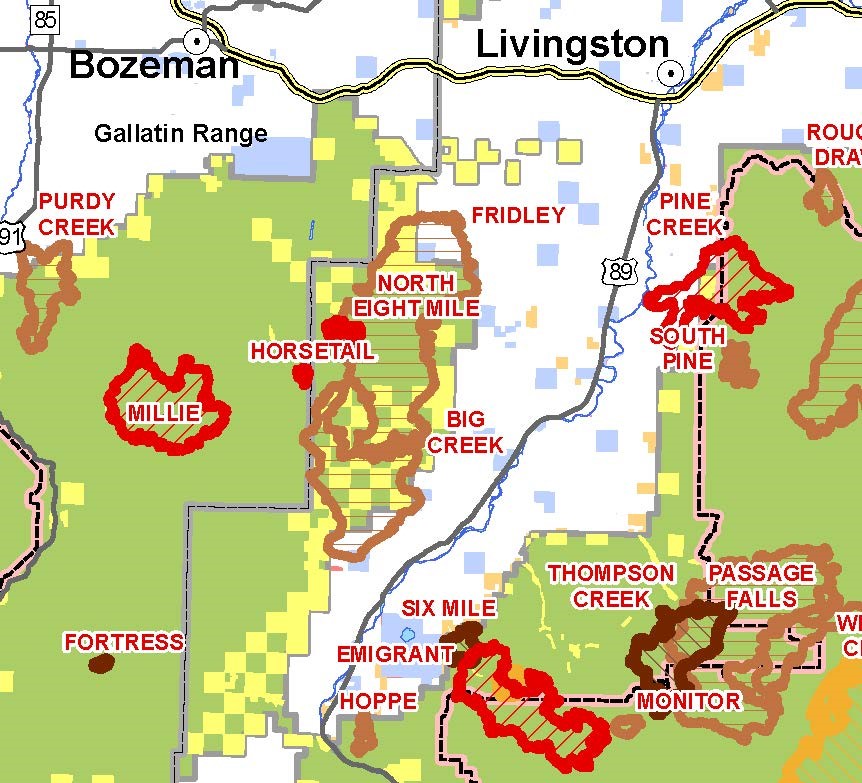
 A lightning strike on a power pole within State Section 16 started the fire. On July 29, 2006, it was 97 degrees and 9 percent humidity. The fire was promptly reported and managed by two U.S. Forest Service incident management teams and several local fire teams. Full perimeter control was used on the north, south and east sides where homes and private land are present.  On the west side, where there were safety concerns and no human values at risk, very limited action was taken. The fire burned a total of 14,000 acres, 6,500 acres of national forest and 7,500 acres of private and state land.  It was declared controlled on October 19, 2006 at a cost of approximately $3 million. On Mountain Sky Guest Ranch, the fire burned some 1,720 acres in the north-central/Dry Creek area.

(photo taken from Leo Drive in South Glastonberry, 7-31-2006).

 “I remember a thunder storm on Wednesday, and high winds. Evidently a lightning strike smoldered till the wind on Saturday ignited it. We sat down for dinner about the same time that the wranglers turned out. Looking up from the picnic tables behind the main lodge, we saw a huge plume of smoke northeast of the upper ranch. The wranglers brought the herd back down and sent them to the lower ranch. The decision was made to evacuate the ranch. And we did.” Randy Venteicher, MSGR Head of Maintenance

Big Creek Prescribed Burn (March 2004, September 2008)
The Big Creek prescribed burns were authorized by the Gallatin National Forest, Paradise Valley Fuels Management and Prescribed Burning Project Decision Memo, on April 7, 2003.   The first prescribed burn, aimed at treating a ≈430-acre area (map), was implemented during the last week of March 2004.  Due to the fact that objectives were not achieved with this burn, the area was burned again in September 2008.  The 310-acre burn required about 130 acres of juniper slashing in 2007.  The burn was accomplished in a prescription burn window on September 14-15, 2008. In 2010, the riparian area between the upper bridge and the Big Creek Ranger Cabin was burned to reduce conifer encroachment and stimulate willow sprouting. Overall project goals were:

1.       Reduce conifer encroachment on grass and sagebrush meadows and aspen stands
2.       Maintain area with their natural fire occurrence and severity
3.       Public and firefighter safety during wildfire events
4.       Allow fire to play its natural role in the HPBH Wilderness Study Areas
5.       Provide and/or maintain existing defensible spaces within the drainage to facilitate fire suppression tactics and staging areas during wildfire events


Resources
Geoffrey Donovan and Thomas Brown. 2007. Be careful what you wish you: the legacy of Smokey Bear. Front Ecol Environ 2007; 5(2): 73–79. www.fs.fed.us/rm/pubs_other/rmrs_2007_donovan_j001.pdf

Susan Stein et al. 2013. Wildfire, wildlands, and people: understanding and preparing for wildfire in the wildland-urban interface—a Forests on the Edge report. Gen. Tech. Rep. RMRS-GTR-299. Fort Collins, CO. U.S. Department of Agriculture, Forest Service, Rocky Mountain Research Station. 36 p. https://www.fs.fed.us/openspace/fote/reports/GTR-299.pdf

Ashley Sites, Zone Fire Management Officer, CGNF, Livingston, MT. Source for information on 2006 and 2008 Big Creek fires.

Stephen Pyne. 1997. Fire in America: A Cultural History of Wildland and Rural Fire. Weyerhaeuser Environmental Books. 680 pages. https://www.amazon.com/Fire-America-Cultural-Weyerhaeuser-Environmental/dp/029597592X


Custer Gallatin National Forest Fire History, 1980-2015 (>100 acres)


Sunday, April 15, 2018


Health Benefits of Being Outdoors


… an eye made quiet by the power         
Of harmony, and the deep power of joy,
We see into the life of things.
 William Wordsworth, Lines Written a Few Miles Above Tintern Abbey (1798)


It is a scientific fact that the occasional contemplation of natural scenes of an impressive character, particularly if this contemplation occurs in connection with relief from ordinary cares, change of air and change of habits, is favorable to the health and vigor of men and especially to the health and vigor of their intellect…  
                                Frederick Law Olmsted, Yosemite Valley and the Mariposa Big Tree Grove (1865)

When Wordsworth, Olmsted and others offered their observations, there was little in the way of supporting research. Today, motivated by the health issues of obesity, depression, ADHD, and pervasive nearsightedness, a growing body of research documents how spending time outside, and being active, secures a wealth of potential benefits, from increasing our immune response to improving short-term memory (Williams 2016).

As we enter the 21st Century, half the human population lives in cities. This urbanized humanity is forecast to rise to 70 percent with the next few decades. Spending up to seven hours per day staring at screens of their mobile devices and computer screens (exclusive of school time!), today’s children are likely to spend half as much time outdoors as their parents.

Richard Louv (2012) cautions that our growing disconnect with nature, our “nature-deficit disorder,” threatens our health, our spirit, our economy, and our future stewardship of the environment. He observes that the more high-tech our lives become, the more nature we need to achieve natural balance, and that the mind/body/nature connection (vitamin N), will enhance our physical and mental health.

Simply stated, being outdoors is good for our mental and physical health. An increasing body of research suggests that people benefit from a “minimum dose of nature.” Here are some insights:

1) Getting Outdoors [typically] Increases Physical Activity.  While you can be active at home or at the gym, we tend to be more active outdoors, from raking leaves to taking a hike. This is particularly true with children who commonly spend a good deal of time indoors, sitting down, and sedentary with their electronic media. One study, which tracked the activity of 1,000 children, found that the children were more than doubly active when they were outside (Harvard Health Letter, 2010).

As Lee (2017) observes, “Think about how much of your time indoors is spent remaining relatively motionless, such as sitting in front of a computer or in a meeting, texting on the toilet or staring at the Kardashians on television. Can you really do the same outdoors without feeling odd or being arrested? Being outdoors in many ways forces you to be more active. Trails make you hike. Hills and mountains make you climb them. Bigfoot makes you run.”

“If outdoor activity encourages more activity, then it is a good thing,” says Jacqueline Kerr, a professor at the University of California, San Diego. After all, “despite the fitness industry boom, we are not seeing changes in national physical activity levels, so gyms are not the answer” (Reynolds, 2013).

2) Sunshine & Vitamin D. Vitamin D helps defend us against everything from cancer and osteoporosis to heart attacks and stroke. Many of us who spend more and more time indoors don't have enough vitamin D. Getting outdoors in the sunshine on a regular basis and exposing our arms and legs for 10-15 minutes will give us a beneficial dose of the “sunshine vitamin.”

A note on sun screen. While sun screens are important to protect our skin from the harmful effects of ultraviolet light, they also inhibit production of Vitamin D since they work to block ultraviolet B (UVB) light, which causes sunburn but also the generation of vitamin D. To strike a balance, experts recommend we get our Vitamin D producing sun for short periods, while using sun screen when out for extended periods, particularly during the middle of the day.

3) Nature Improves Mental Health. Research suggests that when we get outdoors in a natural setting, city park or wildness, our minds get an escape from the busywork, slow down, and simply enjoy the surroundings. The experience restores our energy and sharpens our mental performance. A study conducted by the University of Queensland (2016) demonstrated that 30 minutes of nature exposure per week reduced depression prevalence by up to seven percent.

Researchers at Stanford University (Jordan 2015) found that people who walk for 90 minutes in nature, as opposed to high-traffic urban settings, showed decreased activity in a region of the brain associated with a key factor in depression. City dwellers were found to have a 20 percent higher risk of anxiety disorders and a 40 percent higher risk of mood disorders as compared to people in rural areas. People born and raised in cities are twice as likely to develop schizophrenia.

4) Boost to Concentration. Playing off ADHD, attention deficit hyperactivity disorder, Richard Louv (2006) coined the term "nature-deficit disorder" in Last Child in the Woods. In fact, research has found that children with ADHD seem to focus better after being outdoors. A University of Illinois (2008) study found that children with ADHD scored higher on a test of concentration after a walk through a park than after a walk through a residential neighborhood or downtown area.

5) Helps Prevent Nearsightedness. Nearsightedness (myopia) has been on the rise in children in recent years. In parts of the world where people spend most of their time indoors, rates of myopia have skyrocketed. By adulthood, one in three people in the United States has myopia. In parts of Asia, more than 95 percent of children and teens may wear glasses to correct for myopia. A Canadian study (Science News 2016) found that for one additional hour of outdoor time per week, the risk a child will develop myopia drops by about 14 percent. A systematic review looked at 25 recently published studies and found increased outdoor time to be protective for the development of myopia – about an extra 1.25 hours per day compared with control/baseline time spent outdoors reduced the risk of onset of myopia by 50%. Time outdoors had a stronger protective effect in children aged 6 years compared with kids aged 11 to 12 years enrolled in longitudinal studies (Brien Holden, 2017).

Forest Service Literature Review. The U.S. Forest Service Ecosystem Service Team in Portland, Oregon worked to translate scientific findings from a literature search. Their findings:
·         Researchers are demonstrating the positive effects of nature on blood pressure, cholesterol, outlook on life, and stress reduction. It has also proved beneficial to those with attention deficit disorder (Kuo and Taylor 2004).
·         People who walk 15 to 30 minutes a day are healthier than people who don’t—they have fewer diseases, are less likely to get cancer, have a lower risk of heart attack and stroke, and have better bone density.
·         Walking improves digestion and decreases the risk of intestinal cancer, reduces risk of type II diabetes, and reduces insulin dependency of diabetics. Walking recalibrates energy/fat storage so the body becomes more efficient and trim. Walking helps the kidneys, the lymphatic system, and the joints. It also diminishes some types of arthritis (Hartman 2006).
·         Research at Duke University in 1999 found that a brisk 30-minute walk three times a week was more effective in reducing depression symptoms than Zoloft® alone or Zoloft® and walking, and walkers were less likely to have a recurrence of depression (Hartman 2006).
·         “Parks and other natural environments are a fundamental health resource, particularly in terms of disease prevention” (Maller et al. 2008).
·         Spending time in nature also has been linked to longevity and decreased risk of mental illness in studies in Scandinavia and the Netherlands (De Vries et al. 2003, Grahn and Stigsdotter 2003).
·         Health benefits of nature may also have relevance to injury prevention and control, diabetes, asthma, arthritis, musculoskeletal conditions, and other maladies, including cancer (Li 2009).
·         A Japanese study of men and women on a 3-day/2-night trip to a forest included short walks each day (Li 2009). Blood and urine samples were tested during and following the trip. Results suggest that a monthly trip in nature could provide maintenance levels of cells that work to prevent cancer generation and development, among other benefits.
·         Breathing in antimicrobial compounds found in the essential oils of trees increases relaxation and improves stress management resulting in increased vitality and less anxiety, depression, and anger. It also may decrease risk of psychosocial-stress related diseases.

So the next time that someone tells you to “take a hike,” thank them and get outside.


References
Brien Holden Vision Institute. 2017. Time Spent Outdoors – How Effective in Myopia Prevention and Control? https://www.brienholdenvision.org/news/item/102-time-spent-outdoors-how-effective-in-myopia-prevention-and-control.html

De Vries, S.; Verheij, R.; Groenewegen, H.; Spreeuwenberg, P. 2003. Natural environments—healthy environments? An exploratory analysis of the relationship between green space and health. Environment and Planning. 35(10): 1717–1731.
Ferguson, Jill. 2017. 5 benefits of being outdoors. June 10, 2017. (https://www.huffingtonpost.com/entry/5-benefits-of-being-outdoors_us_5938266ce4b014ae8c69dce0)

Grahn, P.; Stigsdotter, U.A. 2003. Landscape planning and stress. Urban Forestry and Urban Greening. 2: 1–18.

Hartmann, T. 2006. Walking your blues away: how to heal the mind and create emotional well-being. Rochester, VT: Park St. Press. 112 p.


Jordan, Rob. 2015. Stanford researchers find mental health prescription: Nature. Study finds that walking in nature yields measurable mental benefits and may reduce risk of depression. https://news.stanford.edu/2015/06/30/hiking-mental-health-063015/

Kuo, F.; Taylor, A. 2004. A potential natural treatment for attention-deficit/hyperactivity disorder: evidence from a national study. American Journal of Public Health. 94(9): 1580–1586.

Lee, Bruce Y. 2017. 10 Health Problems That the Outdoors Can Help Prevent And Treat. Forbes, January 8, 2017

Li, Q. 2009. Effect of forest bathing trips on human immune function. Environmental Health and Preventive Medicine. 15(1): 9–17.

Louv, Richard. 2006. Last Child in the Woods- Saving Our Children from Nature-Deficit Disorder. Algonquin Books of Chapel Hill. 334 pages.


Maller, C.; Townsend, M.; St. Leger, L.; et al. 2008. Healthy parks, healthy people: the health benefits of contact with nature in a park context. Melbourne, Australia: Deakin University and Parks Victoria.

PerfectMind Blog. 10 Health Benefits of an Outdoor Lifestyle. http://blog.perfectmind.com/10-health-benefits-of-an-outdoor-lifestyle

Reynolds, Gretchen. 2013. The benefits of exercising outdoors. New York Times, February 21, 2013. https://well.blogs.nytimes.com/2013/02/21/the-benefits-of-exercising-outdoors/?_r=1

Oosthoek, Sharon. 2016. Outdoor time is good for your eyes. Science News, December 20, 2016. https://www.sciencenewsforstudents.org/article/outdoor-time-good-your-eyes

University of Illinois at Urbana-Champaign. 2008. A Walk in the Park Improves Attention in Children with ADHD. https://www.sciencedaily.com/releases/2008/10/081015120742.htm

University of Queensland. 2016. Dose of Nature is just what the doctor ordered. https://www.uq.edu.au/news/article/2016/06/dose-of-nature-just-what-doctor-ordered

U.S. Forest Service. Health and Wellness Benefits of Spending Time in Nature. https://www.fs.fed.us/pnw/about/programs/gsv/pdfs/health_and_wellness.pdf


Williams, Florence. 2016. This is your brain on nature. National Geographic (January 2016) https://www.nationalgeographic.com/magazine/2016/01/call-to-wild/

William, Florence. 2017. The Nature Fix. W.W. Norton & Company. 304 pages.

Thursday, March 29, 2018

A Commitment to Experience, Stewardship, and Community


Mountain Sky Guest Ranch has a long history of providing a quality guest experience that is authenticated in a rebooking rate that consistently tops 85 percent. That didn’t happen by accident, rather it happened by design.

In Montana, the Arthur Blank Family of Businesses (AMB) are committed to the Experience, Stewardship, and Community. These three tenets are embedded in the fabric of Mountain Sky Guest Ranch, West Creek Ranch, and the Basecamp and Challenge Course:

Experience: provide authentic experiences and lifelong memories for our guests.

Stewardship: work to develop and implement sustainable business practices that maintain the quality of our landscape.

Community: be socially and economically responsible to the local community and broader society.

Further our actions seek to epitomize AMB's core values -- in particular, leading by example, innovating continuously, and giving back to others.

In Montana, our brand, guest experience, and economic sustainability are inexorably linked to our environment. The ranches are a vital piece of the larger Paradise Valley-Greater Yellowstone Ecoregion that makes up one of the most unique landscapes in the world. As this ecosystem is central to the guest experience, the AMB business model is bound to the future of open space, wildlife habitat, water quality, and human community.

The Paradise Valley, viewed from 50,000-feet presents itself as four principal components (photo below): the dark green of the forestlands, the browns and light greens of range and agricultural lands, the blue ribbons of the Yellowstone River and its tributaries, and the circles, squares, and lines of human communities. Collectively, these are the components that make up the landscape, and they define AMB's work in the region.


Ranching, Open Space, and Wildlife. Montana is known as “Big Sky Country.” It is a description of both the size and the quality of the land, its topography, its flora and fauna, and its human use. For the Paradise Valley, the future of open space, and the wildlife that depends on it, hinges on the preservation of working lands (i.e., ranching, timberland, and recreational industry). Fragmentation of this landscape is the number one concern in the Paradise Valley. While fences, agricultural practices, and the like have their impacts, the primary cause for fragmentation is the loss of traditional ranching.  The preservation of ranching as a prime economic activity, therefore, becomes the single best way to preserve the region’s wildlife, open space, and ecosystem services. To us it means:

·         Experience: Guests get a first-hand look at the landscape with wranglers as their guides
·         Stewardship: Sustainable grazing practices backed up by annual monitoring
·         Community: Grants to Western Sustainability Exchange in support of sustainable ranching

Upper Yellowstone Watershed. The Yellowstone is a complex river, at once iconic while neglected, beloved while ignored, famed for its blue-ribbon fisheries while essential for irrigation water. The river is vital to the local economy yet poorly monitored; it shows signs of ecological stress, yet lacks a champion represented by a broad coalition of interests. To us it means:

·         Experience: Guests fish Big Creek and the Yellowstone
·         Stewardship: Commitment of in-stream flow in Big Creek for fisheries, and regular water quality testing
·         Community: Grants and volunteer time to Upper Yellowstone Watershed Group

Forestlands. The Paradise Valley is encircled by public lands providing a wealth of ecosystem services (e.g., clean water), recreational opportunity, and other contributions. The largest land manger in the region, is the U.S. Forest Service. It is not an exaggeration to state that where goes the national forest, so goes Mountain Sky Guest Ranch and West Creek Ranch.

Being a neighbor to the national forest brings the benefits of grazing leases and multitude of recreational trails. These benefits, however, are counterbalanced by the menace of wildfire, noxious weeds, and trespass. At present, the future of the 155,000-acre Hyalite Porcupine Buffalo Horn Wilderness Study Area, lying adjacent to Mountain Sky Guest Ranch and West Creek Ranch, is uncertain; the Forest Plan is undergoing its first update in 30 years; Forest Service budgets are at all-time lows; and need for constructive community engagement in forest planning and ongoing management is critical. To us it means:

·         Experience: Enjoying an adult beverage watching the light play across the forest
·         Stewardship: Managing juniper encroachment to maintain grasslands and sage-shrub
·         Community: Supporting Future Farmers of America's annual holiday collection of trees and wreath-making materials on the ranches

Community. Author Wallace Stegner observed that when the western United States “fully learns that cooperation, not rugged individualism, is the quality that most characterizes and preserves it… then it has a chance to create a society to match its scenery.” 

The earliest European settlers, awed by the natural beauty and fertile soils along the Yellowstone River, called the place “Paradise Valley,” and it remains so to this day. The economy of Paradise Valley is growing and expanding. It possesses an enviable combination of high-quality amenities (e.g., education, recreation, airport access) combined with abundant scenery. The presence of public lands and deep agricultural roots gives the region a natural competitive advantage for continued economic growth. The upsides of this growth include new job creation and a richer overall social and intellectual fabric. These come with the challenge of managing growth, including sustaining the way of life that residents enjoy and the need to provide quality human services. Growth also unsettles. With a growing population of people “from away,” the community’s cohesiveness is threatened and the status quo is no longer “the way things used to be.” To us it means:

•          Experience: Guests enjoying the annual Livingston Fourth of July Rodeo
•          Stewardship: Basecamp and Challenge Course offered to regional nonprofits
•          Community: Staff volunteering in the Livingston Food Pantry

As we do our work, we are guided by four basic principles: 1) focus on maintaining open space and working lands; 2) recognize that sustainable means land health, profitability, and social capital; 3) cooperate and collaborate; and 4) identify the common ground that unites, not the fringe that divides.


Friday, September 1, 2017

Yellowstone Elk: Conservation and Management


 Figure 1. Bull elk with cows (photo: Gallatin Wildlife Association).

ELK IN THE GREATER YELLOWSTONE

The Greater Yellowstone Ecosystem (GYE) is home to approximately 30,000–40,000 elk. Nine discrete herds, totaling 10,000-20,000 animals compose the Greater Yellowstone “superherd” whose summer range is in the core protected area of the GYE. Come winter, the majority of these animals will migrate to lower elevations, outside the park, while some will remain in the same area year-round. The timing and routes of elk migration closely follow the areas of seasonal vegetation growth and changes in snow depth. After winters with high snowpack, elk delay their vernal migration while in years with lower snowpack and earlier vegetation green-up, elk migrate earlier. There is growing evidence that elk are changing their migratory habits in response to predators: bears, wolves, mountain lions and human hunters. Figure 2 depicts the general location and migratory routes of the nine elk herds, each named for where they winter.

The dynamics of the Paradise Valley herd is highly dependent on private lands and its seasonal migrations have become more constrained. The Northern Herd is the best known and studied herd (along with the Jackson Herd), and the impact of wolves and hunting on population numbers continues to be sharply debated. The Madison Herd summers in and around the Madison Range, and winters in large groups on the high benchlands of the Madison Valley.

Figure 2. Nine distinct herds comprise the Yellowstone Superherd. Research by Arthur Middleton. Map by National Geographic (May 2016).

BIOLOGY/ECOLOGY

Elk (Cervus elaphus) are one of the most abundant large mammals found in the GYE, and they are a vital contributor to the ecology of the region: as prey for large carnivores, carrion for scavengers, and consumers of vegetation. Elk are also an economic mainstay for hunting and tourism in the states of Montana, Wyoming, and Idaho. It is not an overstatement that elk define and unify the GYE, both ecologically and culturally.


While North American’s elk is the same species as Europe’s red deer, the name “elk” is actually the European word for moose. Small wonder that European visitors can get confused on visiting Yellowstone. The species is perhaps better labelled “wapiti,” Shawnee for “white deer” or “white-rumped deer.”

Bull elk weigh about 700 pounds and stand some five feet high at the shoulder; cow elk weigh some 500 pounds and are slightly shorter. Calves are about 30 pounds at birth; born May to late-June, overlapping with periods of peak vegetation green-up and high-nutrition plant phases allowing mothers and calves to build up fat reserves. Elk feed on grasses, sedges, other herbs and shrubs, as well of aspen sprouts and bark, conifer needles, and aquatic plants.

In the fall, bull elk bugle to attract cows and challenge other bulls for dominance. The bugle is not so much a bugle coming from a brass horn as a bellow building to a squeal, terminating in a grunt (listen at https://elknetwork.com/elkfacts/). Dominant bulls gather cows and calves into small groups or harems and then aggressively guard these harems against all comers.

ANTLER MANIA

Bull elk grow massive racks which begin growing in the spring in response to a depression of testosterone levels and lengthening daylight. Yearling bulls grow antlers for about 90 days while healthy, mature bulls grow theirs over a +/- 140 day period. In the later stage of growth, antlers of a mature bull will grow 0.66 inches per day reaching 60” or more in length and weighing some 30 pounds per pair. During much of the summer, “velvet” covers the antlers -- a thick, fuzzy coating of skin, which nourishes and deposits the calcium that forms the antler. Antler growth typically ends in early August, and the bulls begin scraping the velvet off, polishing and sharpening the antler tines in preparation for the coming rut (mating season) in September and October.

Bulls retain their antlers through the winter. When antlered, bulls usually settle disputes by wrestling with their racks. When antlerless, they use their front hooves (as cows do), which is more likely to result in injury to one of the combatants. Because bulls spend the winter with other bulls or with gender-mixed herds, retaining antlers means fewer injuries sustained overall. Also, bulls with large antlers that are retained longer are at the top of elk social structure, allowing them preferential access to feeding sites and mates. Antlers are dropped annually, in March-April, and the process begins anew.

NORTHERN HERD DYNAMICS

The Northern Elk Herd is Yellowstone’s largest herd. Its summer range is centered in the area of the Lamar and Yellowstone river valleys, north of Yellowstone Lake, from Soda Butte to Gardiner, Montana. In winter the herd migrates north outside of the park into the Gallatin National Forest and the lower elevation private lands. With more moderate temperatures and less snowfall than the park interior, the Paradise Valley and surrounds supports large numbers of wintering elk. 


Figure 3. Winter counts of the Northern Elk Herd in Yellowstone National Park and adjacent areas of Montana, 1960–2016. Counts are not adjusted for elk sightability, and gaps represent years where no official count was conducted. Source: NPS.

For decades, debate raged over too many elk and the disappearance of willow and aspen from the Lamar Valley and elsewhere. Control of a burgeoning elk population was one of the main arguments for returning the gray wolf as it would provide a year-round predator to control elk numbers and keep them more dispersed across the landscape.

The winter count was approximately 17,000 when wolf reintroduction began in 1995. The number fell below 10,000 in 2003 and 3,914 were censused in 2013 -- the lowest since culling ended in the park in the 1960s. Decreased numbers are attributed to large carnivore recovery (wolf, bears, mountain lion), hunter harvest, and drought-related effects on pregnancy and survival. A total of 4,844 elk were counted in winter 2015 with the expressed hope that the elk decline has stabilized as efforts to maintain wolf numbers have also been implemented (Figure 3).

There is little doubt that the return of gray wolves have altered elk behavior -- group sizes, habitat selection, movements, distribution, and vigilance. There are some indications that elk–wolf interactions are contributing to a release of willows and other woody vegetation on the northern range. At the same time, the debate continues over the overall condition of the Northern Yellowstone range and its carrying capacity, with several range specialists continuing to point out that the range is seriously overstocked by bison and elk.

DISEASE

Many elk and bison in the Greater Yellowstone Ecosystem have been exposed to the bacterium that causes brucellosis. Brucellosis is a contagious bacterial disease that originated in livestock and often causes infected cows (cattle and elk) to abort their first calves. It is transmitted primarily when susceptible animals directly contact infected birth material. No cure exists for brucellosis in wild animals.

Because of their high densities, elk that are fed in winter have sustained high levels of brucellosis. Winter feeding on the Northern Range stopped more than 50 years ago but winter feeding of elk continues at the National Elk Refuge in Jackson, Wyoming, in addition to 22 Wyoming-run feed grounds. The feed grounds were created in the 1900s to maintain Wyoming’s elk herds and limit depredation as migratory routes from summer range to lower elevation winter ranges became blocked by settlement in the Jackson area. Transmission of brucellosis from feed ground elk, where an average of 30% have tested positive for exposure to the bacteria, was the apparent source of infection in Wyoming cattle in 2004.

Elk, deer, and moose in Greater Yellowstone are at moderate risk for exposure to chronic wasting disease (CWD). This fatal infection, transmitted by animal contact or through the environment, has spread to within 130 miles of the park from the southeast.

FALL HUNTING & SPRING SHED HUNTING

The “Welcome Hunter” banners hanging on the front of local taverns, gas stations and restaurants, and the “No Vacancy” signs at local motels in the fall signal the importance of big game hunters, both resident and non-resident, to Idaho, Montana, and Wyoming’s economy. In 2016, big game hunters in Montana spent an estimated $324 million and supported more than 3,300 jobs.


Elk Hunting by State, 2014, State-wide and in the GYE (National Geographic, May 2016)

Idaho
Montana
Wyoming
Elk Population (state-wide)
105,000
160,000
114,600
Elk Harvested state/GYE
20,600/2,710
25,735/7,310
25,905/10,666
Hunters state/GYE
85,000/12,866
107,663/29,446
58,266/29,957
Elk License Fees*
$43.50/$571.50
$47.00/$860.00
$69.50/$603.50
Includes license, tags, and processing fees for 2016


Shed hunting, the hunting of the cast-off antlers of elk, deer, and moose, has become increasingly popular in recent years, leading to more competition among shed hunters, more conflicts with private land owners from trespass and vandalism, and more impact on big game herds. State Wildlife Management Areas and ranchers are reporting a growing number of incidences. There have even been reported cases where individuals have run antlered elk through trees in early spring in the hope of breaking off antlers.

Currently there are no seasons or required licenses for shed hunting. But that may change as many shed hunters take to the field to gather antlers during the worst time of the year for the animals themselves. Wintering big game animals are very susceptible to any kind of disturbance, especially in the late winter and early spring. At that time of year elk, deer and moose are just trying to hang on until spring green-up, drawing from their diminished body reserves and what little nourishment they can get from surrounding vegetation (like conifer needles and bark). Disturbance from passing motorists, snowmobilers, skiers, dogs, or shed hunters, who intentionally or unintentionally enter areas where elk are bedded down, depletes the little energy the animals have left. This stress and energy depletion leads to sickness and oftentimes death, especially for fawns and calves at this critical time of year.

Ethical shed hunting focuses on not disturbing big game animals on their bedding grounds, respecting public land closures and posted private lands, keeping dogs under control.

Antlers or Horns?

Antlers, found on members of the deer family, grow as an extension of the animal’s skull. They are true bone, are a single structure, and, generally, are found only on males.

Horns, found on pronghorn, bighorn sheep, and bison, are a two-part structure. An interior portion of bone (an extension of the skull) is covered by an exterior sheath grown by specialized hair follicles (similar to human fingernails).

Antlers are shed and regrown yearly while horns are never shed and continue to grow throughout an animal’s life. One exception is the pronghorn, which sheds and regrows its horn sheath each year.

  • Average, healthy, mature bull has 6 tines on each antler: a "six point" or "six by six."
  • One-year-old bulls grow 10–20 inch spikes, sometimes forked.
  • Two-year-old bulls usually have slender antlers with 4 to 5 points.
  • Three-year-old bulls have thicker antlers.
  • Four-year-old and older bulls typically have 6 points; antlers are thicker and longer each year.
  • Eleven- or twelve-year old bulls often grow the heaviest antlers; after that age, the size of antlers generally diminishes.

RESOURCES AND REFERENCES


On the Path of Yellowstone’s Elk, Nathan Martin. The Atlantic, June 21, 2016.  https://www.theatlantic.com/science/archive/2016/06/on-the-path-of-yellowstones-elk/488063/

Yellowstone Resources and Issues Handbook. U.S. Department of the Interior, pages 200-204.

Yellowstone. National Geographic, May 2016

Elk Facts. Rocky Mountain Elk Foundation. https://elknetwork.com/elkfacts/


Eek! A Spider Wolf spider (Photo: Flicker sharing, Thomas Shahan) Arachnophobia, a fear of spiders, is a common and powerful fear...